The short answer: no, the rego hike is not killing the motorcycle industry, but it is hurting riders, and it is landing on a market that was already in trouble.
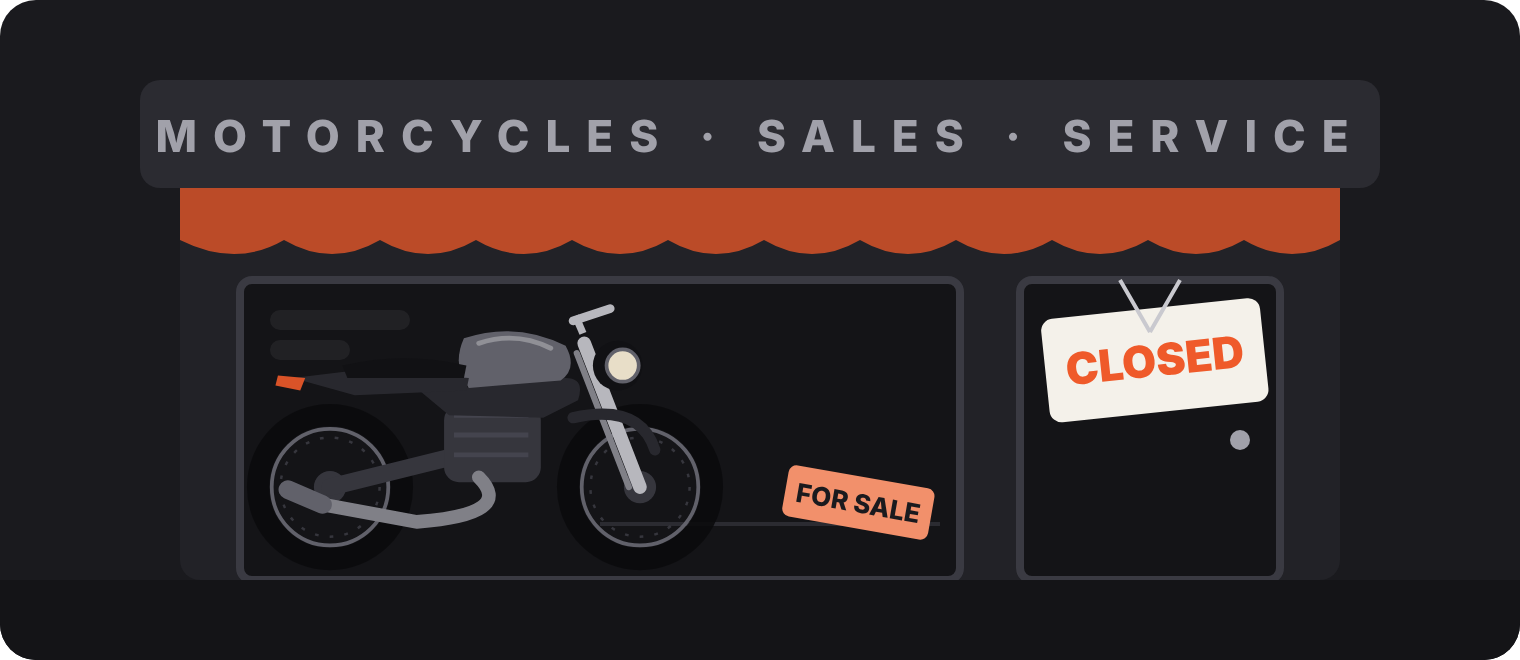
In February 2026, Invercargill’s Crawford Motorcycles, trading as Southern Suzuki and Southern Motorcycle Centre, and in business since 1982, was placed into liquidation. The liquidator’s six-monthly report lists 28 creditor claims totalling $535,739.80 against estimated assets of just $18,640.94 (Stuff). Inland Revenue is owed about $166,000 in GST and PAYE, four staff are owed nearly $18,000 in holiday pay, and the liquidator expects nothing for preferential or unsecured creditors.

It is not the only casualty. Te Kuru Holdings, trading as Hamilton Motorcycle Centre, went into liquidation in July 2024 (NZ Gazette). Tauranga electric-bike maker Ubco went into receivership in January 2025 owing $35.7 million and, despite a $5 million rescue, ended up in liquidation (BusinessDesk).
It is tempting to draw a straight line from these collapses to the ACC levy. But look at what Crawford’s own liquidation papers blame: a downturn in sales and rising costs, not registration fees. And the business stopped trading in early 2026, months before the big levy increase took effect on 1 July 2026.
The wider picture is also less dramatic than the headlines. Stats NZ counted 264 motorcycle retail businesses in 2015 and 258 in 2025 (The Press), a net loss of six over a decade. Painful for those owners, but not an industry wipe-out.
How much has rego actually gone up?
For big bikes, a lot. Total annual rego for a motorcycle over 750cc went from about $540 in 2025 to $816 from 1 July 2026, and is set to reach around $960 in July 2027 (1News). That is roughly 51% in one year and close to 78% over two.
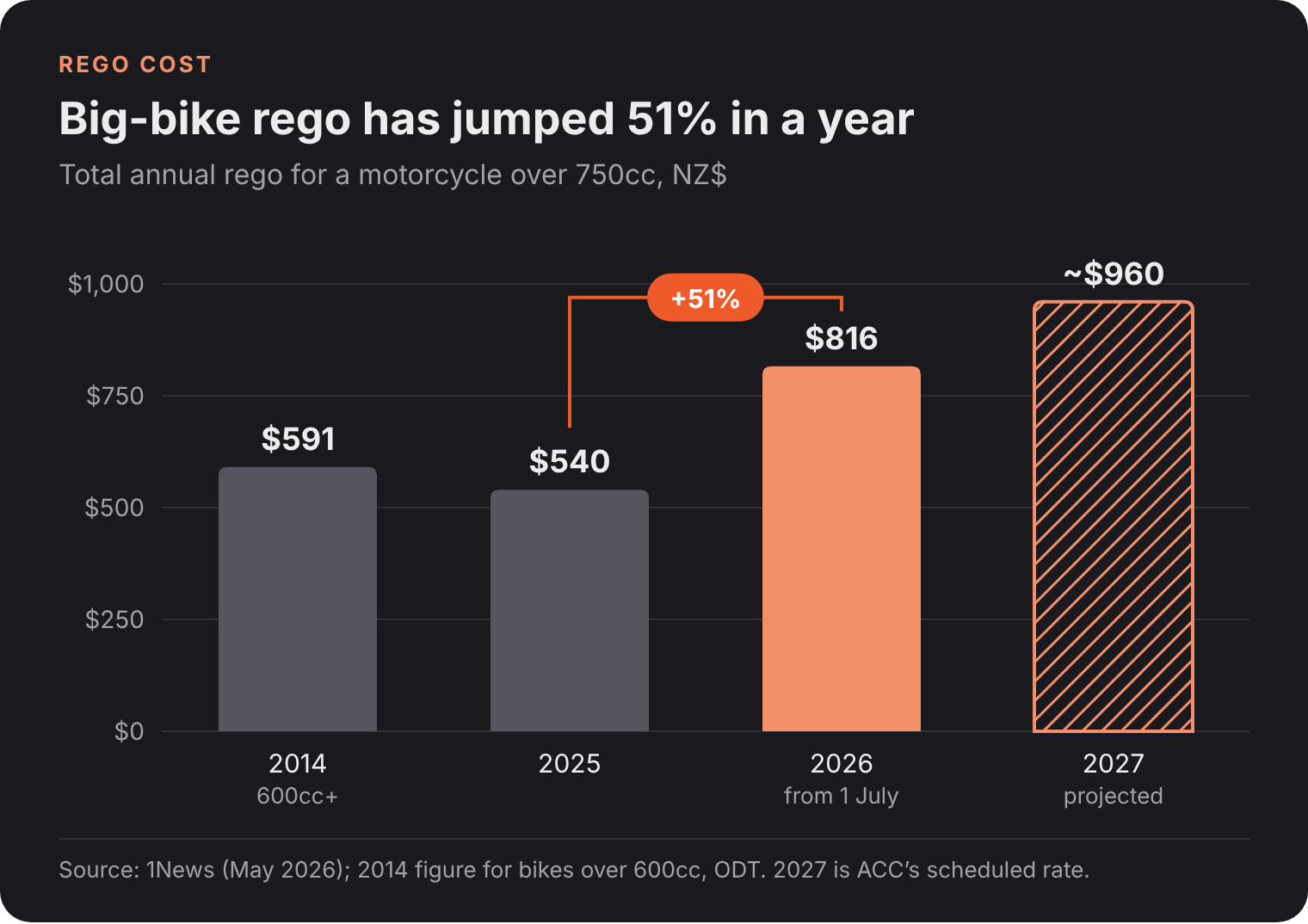
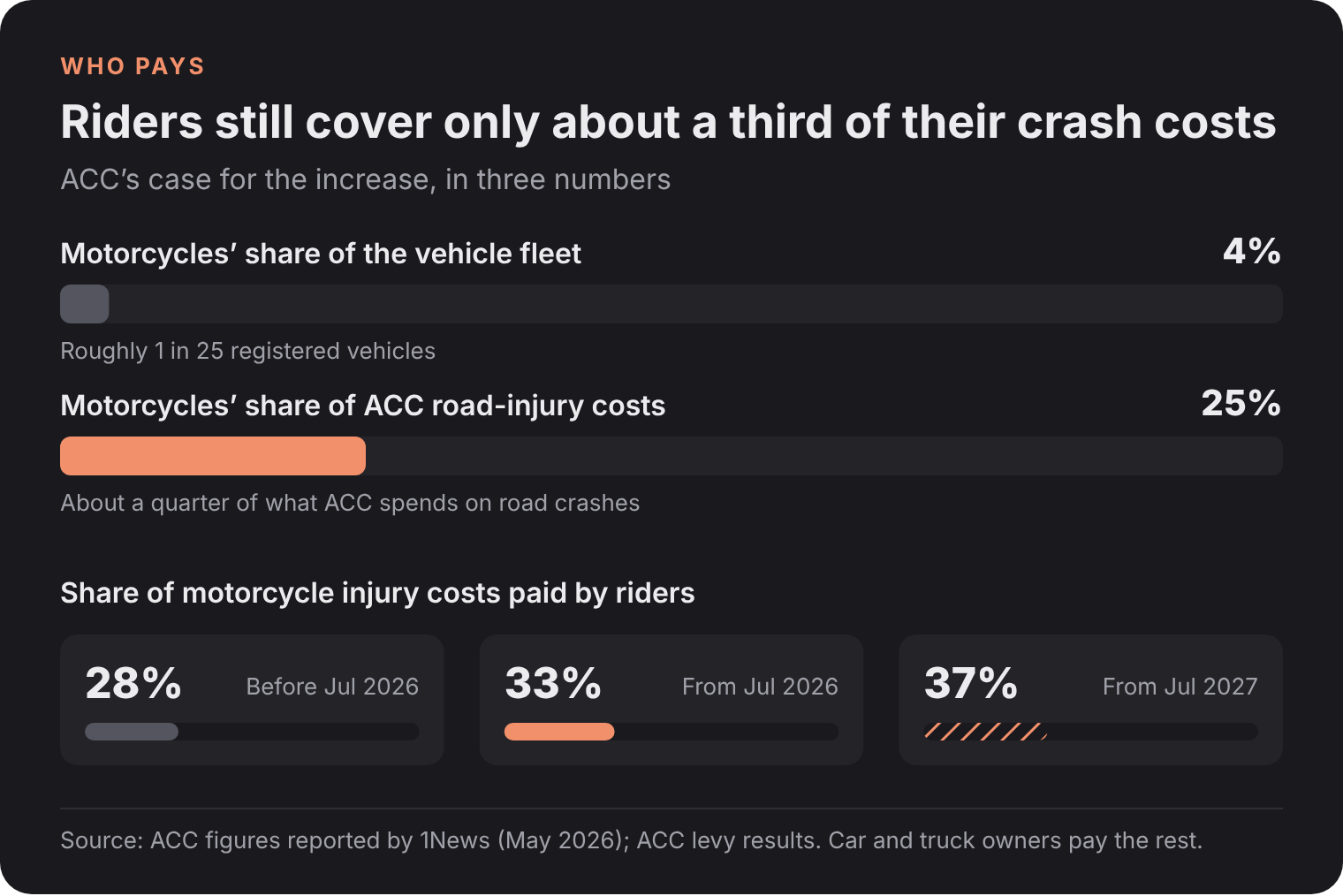
Almost all of that is the ACC levy. From 1 July 2026, ACC split motorcycles into three engine-size bands and lifted the share of motorcycle injury costs riders pay from 28% to 33%, rising to 37% in July 2027 (ACC).

Source: NZTA, ACC. Every bike also pays a flat $25 Motorcycle Safety Levy. Riders who complete an approved Ride Forever advanced course get 25% off the ACC levy.
Two things stand out. First, learner-sized bikes (250cc and under) actually got slightly cheaper, so the entry point into motorcycling is not where the pain is. Second, the hit is concentrated on mid-size and large bikes, exactly the higher-margin machines dealers rely on.
There is also a sting for enthusiasts: the levy is charged per bike, not per rider. Someone who owns a road bike and a tourer pays twice, even though they can only ride one at a time.
The numbers: registrations were already sliding
New motorcycle registrations have dropped by about a third since 2021, and most of that fall came before anyone paid a cent more in ACC levy.
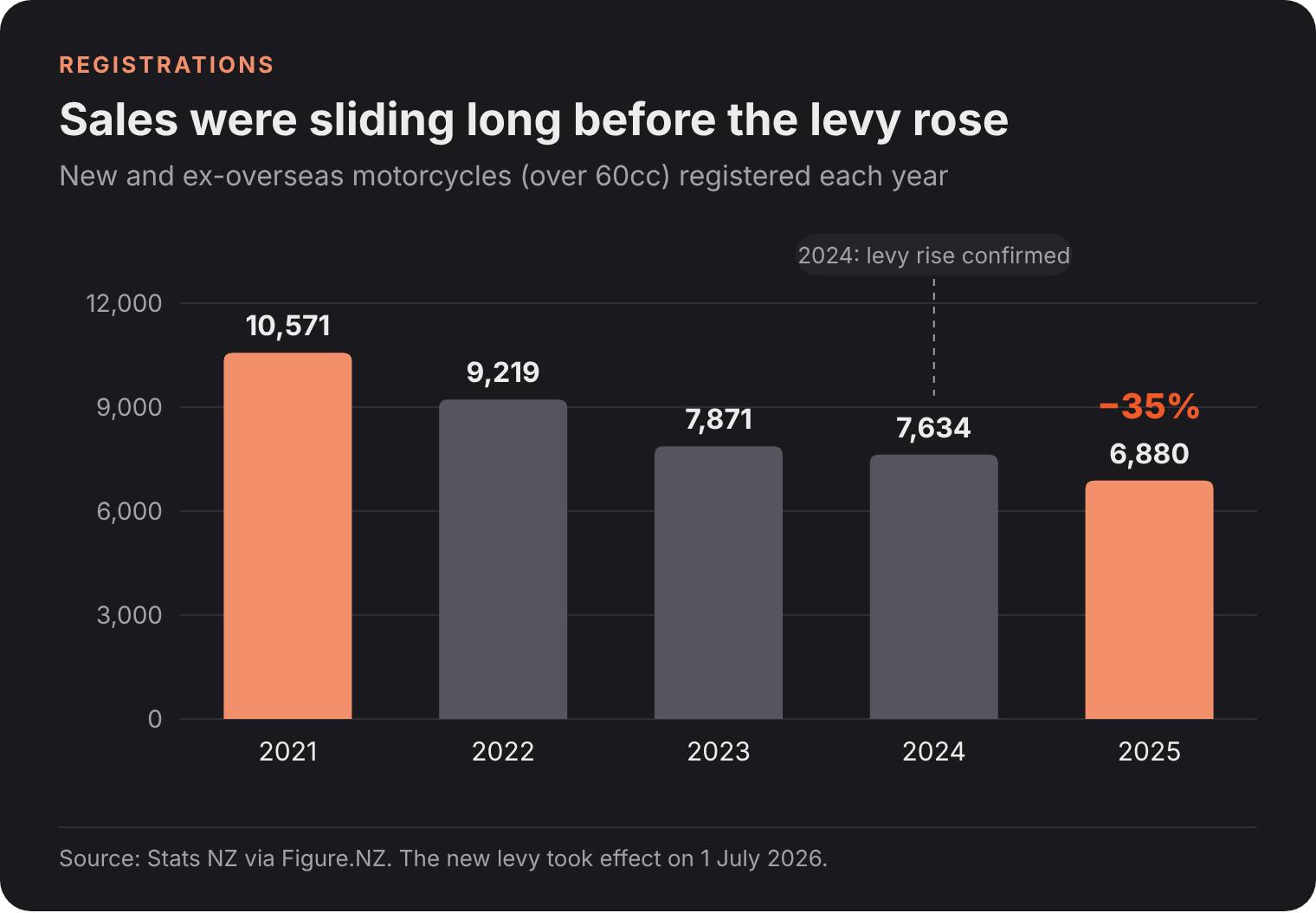
The chart shows bikes added to the register, not bikes on the road. The 2026 picture is mixed: new registrations in January–June 2026 were up about 8% on the same months of 2025, while the number of existing bikes with rego on hold rose sharply (see below).
The case that rego is the culprit

Riders are parking their bikes. NZTA snapshot counts released under the Official Information Act show motorcycles on exemption (rego “on hold”) rose from 85,635 on 31 December 2025 to 103,364 on 31 May 2026, up 17,729, or about 21%, in five months (Scoop / MAGNZ). The biggest jump was in bikes over 750cc, the class facing the largest increase: up about 28%.
The paying base is shrinking. Licence-months bought for bikes over 750cc fell from 35,102 in July 2025 to 24,564 in July 2026, a drop of about 30%. Across all motorcycle classes the fall was about 16.8% (Scoop / MAGNZ). The advocacy group estimates a 46% levy rise on big bikes produced only about 2% more July revenue from that class.
Fewer new bikes are going on the road. NZTA data shows first-time motorcycle registrations fell 9.8% between the March 2025 and March 2026 years, while passenger car registrations rose 2.7% over the same period (RNZ).
It hits the dealers’ best customers. The 251–600cc and over-750cc bands carry the steepest rises. These are the bikes with the fattest margins and the owners who spend most on servicing, tyres and gear. A dealer that sells fewer of them loses more than one sale.
Riding less means less of everything. A bike on hold for half the year needs fewer services and fewer tyres. Workshop income is the steady earner for most shops, so a nationwide “rego freeze” bites the after-sales side even if new-bike sales hold up.
A note on the numbers. The exemption and licence-month figures come from the Motorcycle Advocacy Group (MAGNZ), which is campaigning against the levy and has encouraged riders to put rego on hold. The underlying numbers are NZTA’s, but the framing is not neutral. An earlier NZTA alert had found only a 1% rise in bikes on hold between March 2025 and March 2026.
The counter-case: the slump started before the levy
The timing doesn’t fit. New and ex-overseas motorcycle registrations peaked at 10,571 in 2021 and fell every year after: 9,219 in 2022, 7,871 in 2023, 7,634 in 2024 and 6,880 in 2025 (Stats NZ via Figure.NZ). Most of that 35% slide happened before the levy changes were even confirmed in 2024, and well before they bit in July 2026.
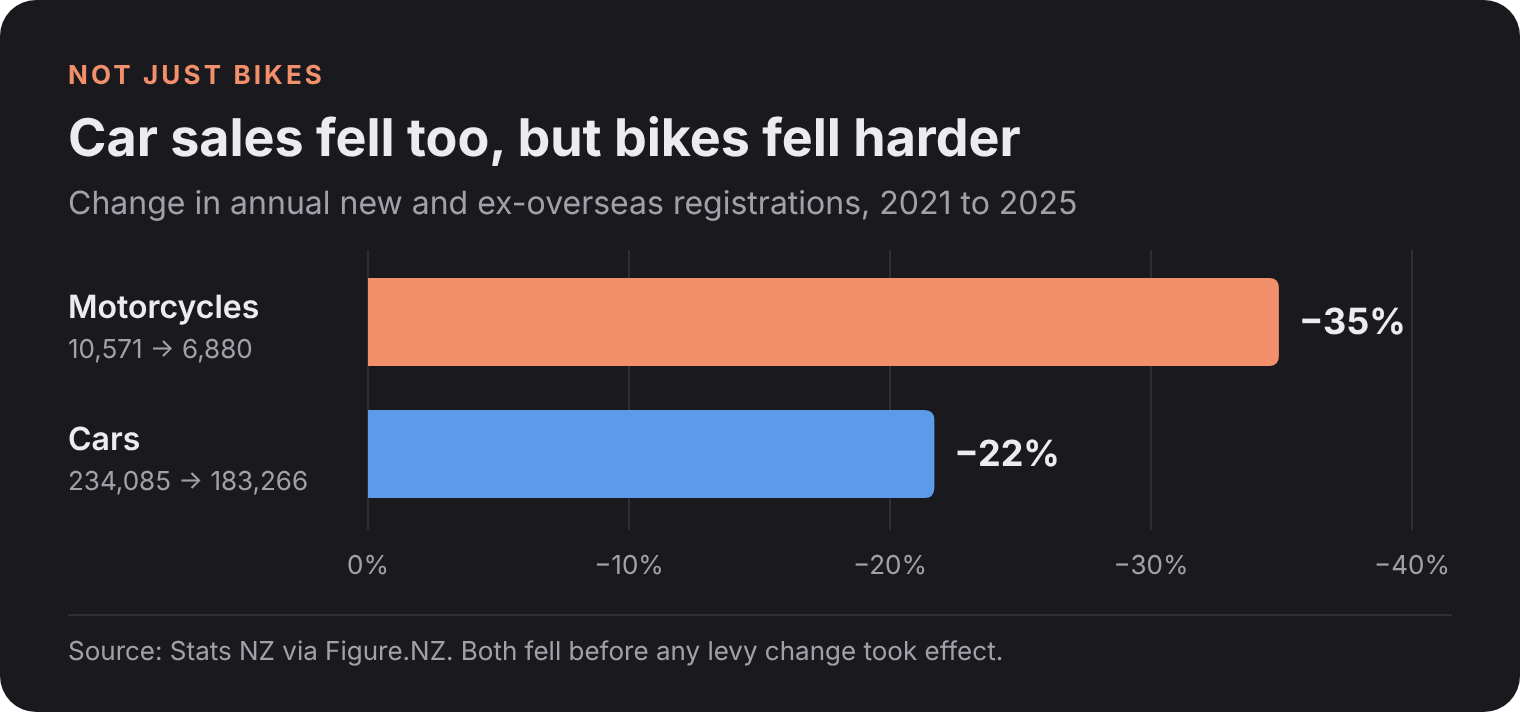
Cars fell too. Car registrations dropped from 234,085 in 2021 to 183,266 in 2025, about 22% (Stats NZ via Figure.NZ). Bikes fell harder, but the shared trend points to the same culprits: high interest rates, a recession, the cost-of-living squeeze and the hangover from a Covid-era buying boom that pulled sales forward.
2026 sales actually picked up. In the first half of 2026, 3,668 motorcycles were newly registered, compared with 3,399 in the first half of 2025, up about 8%. April to June 2026, the months right before the levy jump, were up about 25% on the same months a year earlier (Stats NZ via Figure.NZ). That is not what an industry in free-fall looks like.
We have been here before. ACC levies on bikes jumped sharply in 2010, with rego for bikes over 600cc reaching $591 by 2014. Riders protested and put bikes on hold then too. Yet the number of registered motorcycles still grew from 105,479 in 2009–10 to 130,439 in 2013–14 (ODT). Riders adapted, mainly by licensing for shorter periods, rather than giving up.
ACC’s numbers are hard to wave away. Motorcycles are about 4% of the fleet but account for around 25% of ACC’s road crash injury costs. Even after the increase, riders pay only about a third of those costs; car and truck owners pick up the rest (1News). ACC also says motorcycle levies had not risen since 2014 before this round (RNZ).
Dealer trouble is global. Harley-Davidson dealers in the US are closing as sales sag and floor-plan interest bites (Fast Company), and a Jersey dealer has cut back after a sharp fall in demand (Jersey Evening Post). Neither has a New Zealand ACC levy. Shifts toward smaller bikes, online parts sales and costly manufacturer demands on dealers are squeezing margins everywhere.
The levy isn’t killing dealers overnight. It’s a slow-burn threat that trims the after-sales income that keeps them alive.
Verdict: an accelerant, not the cause
The numbers don’t support the claim that rego is killing the industry. Sales were sliding for three years before the levy rose, cars fell alongside bikes, dealer numbers have barely moved in a decade, and new registrations were actually up in the first half of 2026. The dealers that have failed point to sales and costs, not ACC.
But the numbers don’t let ACC off the hook either. The real damage is showing up in a different place: how many bikes are legally on the road. Tens of thousands more bikes are on hold, big-bike licence-months are down about 30%, and the extra revenue ACC hoped for looks thin. If riders own the bike but don’t license it, ACC gets less, workshops see less, and some riders will be tempted to ride unregistered.
That makes the levy a slow-burn threat. It won’t close dealers overnight, but it trims the after-sales income that keeps them alive, and it makes a mid-size or large bike a harder sell to a buyer already counting every dollar. For a struggling dealer, that can be the last straw.
Where the debate goes from here
ACC’s next levy consultation is in 2027, and it is the place for change. Options already on the table each have trade-offs:
Levy the rider, not the bike.
Fairer to multi-bike owners, but harder to administer and would cut revenue unless the per-rider rate rose.
Distance- or use-based levies.
Ties cost to riding, but needs tracking or odometer reporting.
Bigger safety discounts.
The 25% Ride Forever discount rewards training; a larger or longer one could cut both crashes and costs.
Keep the current path.
Defenders argue other road users shouldn’t subsidise riders, and that riders still pay only about a third of their injury costs.
Whichever way it goes, the next round should be decided on data both sides can see: injury costs by engine size, the true revenue effect of the rego freeze, and what is happening to dealer numbers. Right now each side is reading the same figures to suit itself.