By 2030, every Yamaha engine with a DiASil cylinder will be cast from recycled aluminium. Yamaha announced the switch from its Iwata headquarters on 6 October 2026. It says the change will cut about 47,000 tonnes of CO2 a year, and commuter scooters built in Indonesia get it first.
The cylinder is the hardest-working part of an engine, and until now Yamaha would only use virgin aluminium there. The company says it has finally solved the quality problems that held recycled metal back.
What Yamaha announced
One part, every DiASil engine, done by 2030.
- The partYamaha’s all-aluminium DiASil cylinder
- The changeVirgin aluminium alloy replaced by a new recycled aluminium alloy
- The scopeAll DiASil-equipped motorcycles and scooters
- The deadline2030
- The savingAbout 47,000 tonnes of CO2 a year once complete
Yamaha says the new alloy performs like virgin aluminium and runs through the same production processes, so factories don’t need new casting methods. It hasn’t published the alloy’s composition or named the first models.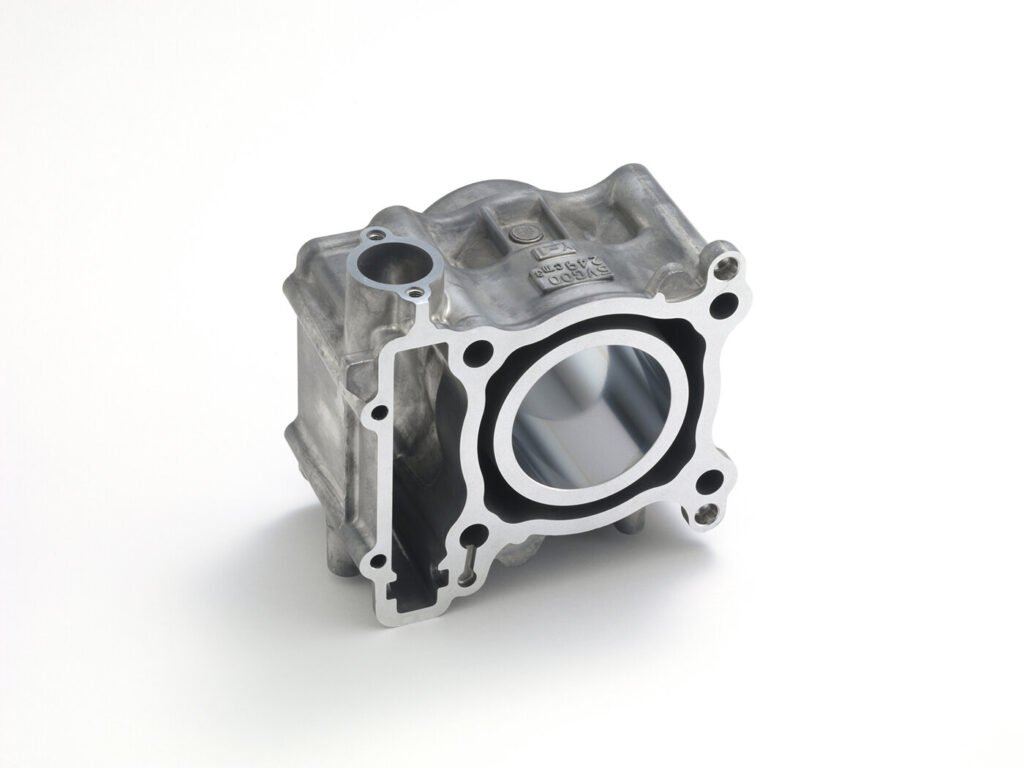
DiASil cylinders explained
No steel liner, no plated bore – just aluminium and silicon.
DiASil stands for “Die-casting Aluminium-Silicon”. It’s a one-piece aluminium cylinder with no steel liner and no plating. Yamaha says it was the first in the world to develop and put one into production, back in 2002.
The secret is silicon. Yamaha’s 2002 launch release describes a 20% silicon aluminium alloy. Hard silicon particles on the bore surface take the piston’s wear, while oil collects on the flat areas between them – doing the job that cross-hatched grooves do in a steel liner.
The casting is the hard part. Yamaha’s Controlled Filling (CF) die-casting process tightly controls die vacuum, die temperature and injection speed. At launch, Yamaha said it cut gas bubbles to about 20% of conventional levels.
About 30% lighter
Than a cylinder with a cast-steel liner.
About 60% better cooling
On par with nickel-plated bores.
About 30% cheaper to make
And easier to recycle, as it’s a single metal.
Figures from Yamaha’s 2002 DiASil launch release, compared with a cast-steel-liner cylinder.
Why recycled aluminium, and why it took so long
Huge energy savings – but impurities were the catch.
Recycling aluminium takes a fraction of the energy of making it from scratch. The International Aluminium Institute puts the figures like this:
Energy per tonne, global figures (International Aluminium Institute). That’s a 95.5% saving.
The catch is purity. Yamaha says conventional recycled aluminium carries trace impurities, which made it hard to meet DiASil standards for metal microstructure, surface properties and corrosion resistance. For a bore that relies on evenly spread silicon particles, that matters.
So Yamaha’s engineers designed a new alloy using thermodynamic calculations, then ran repeated bench tests and on-bike evaluations. Yamaha says the alloy met every functional requirement. Its published micrographs show silicon particles of similar size and spread in recycled and virgin cylinders.
Indonesia first
High-volume commuters lead the way.
The switch starts with commuter models produced in Indonesia. Yamaha hasn’t said which models, or when the change reaches its other factories. Starting with high-volume commuter engines moves a lot of aluminium quickly.
- 2002DiASil cylinder introduced
- Oct 2026Recycled alloy announced
- NextIndonesian commuter models switch
- 2030All DiASil products on recycled alloy
The bigger picture
Part of Yamaha’s plan for carbon neutrality by 2050.
The move sits within the Yamaha Motor Group Environmental Plan 2050, which targets carbon neutrality across Yamaha’s whole supply chain by 2050. That covers Scope 1 and 2 emissions from its own operations, plus Scope 3 emissions from its value chain.
There’s a nearer goal too. By 2030, Yamaha wants 100% of the aluminium used in its own manufacturing – at major production bases in Japan and overseas – to come from sustainable sources. It calls the DiASil switch one of the key measures toward that target.
What it means for riders
Same engine feel, smaller footprint.
The rider’s angle: if Yamaha’s testing holds up, you shouldn’t notice a thing. The recycled cylinder is meant to match the old one for wear, seizure resistance and cooling, and it’s made the same way.
What changes is the carbon footprint behind the bike. A 47,000-tonne yearly saving from a single component shows how much material choices can matter as manufacturers chase their 2050 goals.
Sources: Yamaha Motor news release (6 Oct 2026) · Yamaha: DiASil Cylinder · Yamaha: 2002 DiASil launch · Yamaha: Environmental Plan 2050 · International Aluminium Institute · Visordown